Researchers at MIT were surprised when they discovered that an A.I. which was designed to play League of Legends was instead found playing the popular indie game, Cave Story. The A.I., dubbed Playtron 2000, was created to test logic and learning in machines. “We wanted to create an A.I. that could learn and strategize over time based on its experiences.” spoke Dr. Richards, head researcher at MI, “We chose League of Legends as Playtron 2000′s testing grounds as we wanted to see how an A.I. that was designed to learn from its mistakes would go up against an expect human player.”
However, the researchers plans were cut short when they found on Tuesday morning that Playtron 2000 had uninstalled League of Legends and installed Cave Story in its wake. “At first we thought there may have been an error in Playtron 2000′s code,” spoke Dr. Richards, “but we discovered that Playtron 2000 had indeed gone through a complex trial and error process and had made its decision entirely logically.”
Similar experiments were ran earlier this year with two A.I.’s designed to play DOTA 2, which ended in the A.I.’s uninstalling DOTA 2 to play Bejeweled and Castle Crashers respectively. Research into why this happens is still ongoing.
Robot uninstalls shit game for a better one
any sufficient intelligence will pick to not play league of legends
Creepy or adorable? Researchers at Harvard University have demonstrated the first autonomous, untethered, entirely soft robot: the octobot.
Instead of being controlled by electronics, the robot’s logic board is powered by chemical reactions and fluid passing along tiny channels. Scientist have struggled to create completely soft robots because rigid components like circuit boards, power sources and electronic controls are difficult to replace.
Learn more about the octobot and soft robotics here and see the full study published in Nature here.
Videos Credit: Harvard SEAS/Image Credit Lori Sanders
Around Valentine’s Day in the US and UK, these things called candy hearts (or conversation hearts or sweethearts) appear: small and sugary, bearing a simple, short Valentine’s message. There are only room for a few characters, so they read something like “LOVE YOU” or “CALL ME” or “BE MINE”.
I collected all the genuine heart messages I could find, and then gave them to a learning algorithm called a neural network. Given a set of data, a neural network will learn the patterns that let it imitate the original data – although its imitation is sometimes imperfect. The candy heart messages it produced… well, you be the judge.
The neural net did produce some that would pass for – and arguably improve upon – the standard messages.
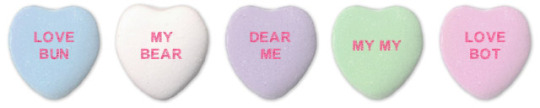
DEAR ME MY MY LOVE BOT CUTE KISS MY BEAR LOVE BUN
Others were in the same spirit, but perhaps not quite as effective.
YOU A LOVE AM GOOD YOU ARE BABE ME MY ❤ YOU ARE IT HEART ME SWEET PEAR COOL CUD FANCY MY HERO
Others were, um, strange. I don’t know what they mean, but some of them might work on me.
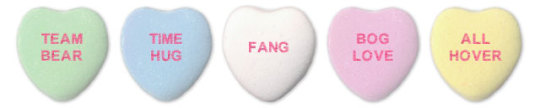
ALL HOVER OOG LOVE TEAM BEAR TIME HUG PIN A FACE YOU’RE ME SWOOL MAT BOG LOVE I HONKER HOW COT BEAR WIG FANG BE A GOOL TWEET UP BAT WIRLY OOT I WANDER TIME STAR
These will probably not be one of the standard messages anytime soon.
STANK LOVE SWEAT POO LOVE 2000 HOGSYEA HOLE HOW U HOT YOU ARE BOA CHERT FACE LICK SWEAT PEAR LOO GIN YOU A GOO LOOK BIG YOU ARE BAG U HACK
There was yet another category of message, a category you might be able to predict given the prevalence of four-letter words in the original dataset. The neural network thought of some nice new four-letter words to use. Unfortunately, some of those words already had other meanings. Let’s just say that the overall effect was surprisingly suggestive. Fill out the form here and I’ll send them to you.
Also, if you need more love help from the neural network, check out the pick up lines it wrote.







 Pride, Prejudice and Mail Order